Navigating the shifting media paradigm and future prospects
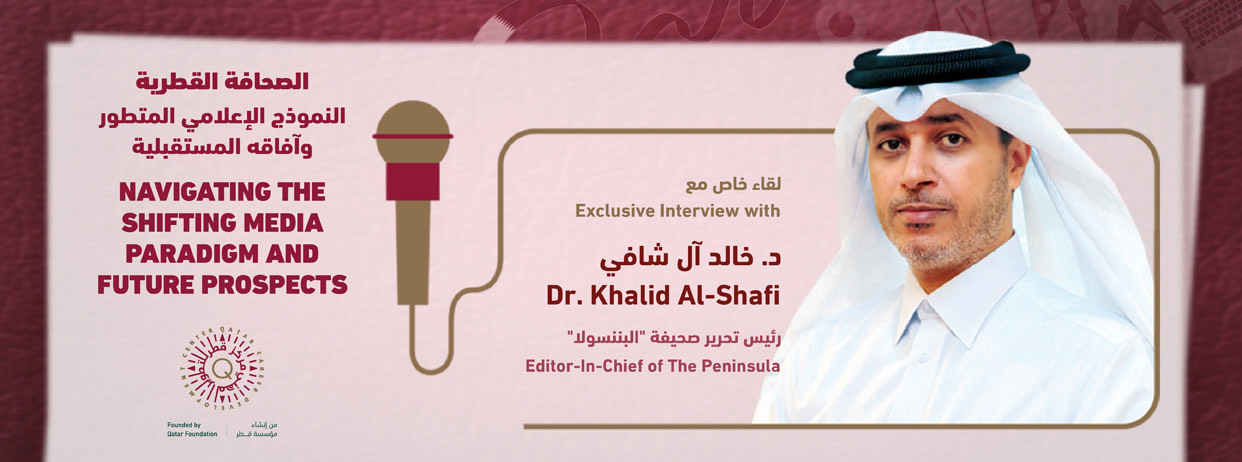
Qatari journalism, under the guidance of many inspiring visionaries, is more than a profession; it is an integral part of the nation’s development. This legacy is rooted in the unparalleled support for media freedom and decentralization since the sector’s inception. The Qatari media landscape, with its revolutionary approach, has blossomed into an entity that transcends regional boundaries. As a testament to this, the evolution of local media was not confined to news dissemination; it has since evolved into a sphere of interaction, influence, policy-making, and shaping public opinion. In today’s intricate media landscape, Qatari journalism plays a pivotal role in crafting a genuine Arab understanding and self-perception amid the ever-evolving digital era.
Dr. Khalid Al-Shafi, a distinguished Qatari journalist and the Editor-in-Chief of The Peninsula newspaper, an English daily which holds a central position within this media arena, being one of the inspiring individuals to propel its development and growth. He also serves as an Assistant Professor in Mass Communication at Qatar University. With a Ph.D. in Media, his career trajectory has been marked by accomplishments and contributions that have significantly impacted the country’s media landscape. Al-Shafi’s journey began at Qatar News Agency (QNA) in 1991, where he ascended through the ranks to eventually become the Managing Editor. He further assumed vital roles in various ministries, from the Ministry of Business and Trade, now known as the Ministry of Commerce and Industry, to the Ministry of Foreign Affairs, including acting as the Deputy Head of Mission and Chargé d’Affaires in Thailand. With a rich history in Qatari journalism, Al-Shafi’s insights reflect the transformation and potential of media, paving the way for the future. We had the privilege of engaging in an illuminating conversation with him to delve deeper into his perspectives and unravel the intricate and deeply rooted scene of Qatar’s media landscape.
Let’s start by discussing your career in journalism and the media. Why did you choose this field specifically?
I began my journalistic work at an early age, with my first professional engagement being as an intern editor at Qatar News Agency. I learned a great deal during my years there, which encouraged me to pursue my university studies in the field of Mass Communication. I gradually advanced through the journalistic ranks at the agency, eventually becoming the Editor-in-Chief. This experience was pivotal in deepening my passion for journalism, prompting me to continue my postgraduate studies in the same field. I earned a Ph.D. in Media, supplementing practical experience with academic knowledge. From the outset, I recognized that journalism required patience, perseverance, humility, and a willingness to let go of certain comforts found in other careers.
Was your family supportive of this decision?
Undoubtedly, sustaining both practical work experience and education simultaneously for an extended period of time without the support of family and conducive circumstances would have been challenging.
Based on your role as an Assistant Professor at Qatar University, do you believe the upcoming generations can build on the achievements Qatar has made in the media field over the past decades?
Qatar has asserted a robust media presence regionally and globally, through notable publications like “Al Doha” and “Al Saqr” magazines, which used to be distributed across the Arab world. The diverse television channels and distinguished Arabic and English print media in Qatar have also showcased its media prowess. Given the country’s substantial support and resources directed toward its media, the outstanding performance is likely to persist. Qatari youth, armed with modern technological knowledge, will continue proving their excellence across visual, auditory, and even digital media platforms. This bodes well for the rise of talented media professionals, as training opportunities are accessible to all and the existing infrastructure in Qatar stimulates work and facilitates success. Thus, seizing these opportunities and maintaining dedication to the craft is essential.
Do you observe reluctance among Qatari youth to pursue careers in fields like journalism or communication?
I don’t believe there’s reluctance toward media work. In fact, there’s an increasing demand for media-related jobs in general. This necessitates continued support and incentives to foster creative Qatari youth in these careers.
With the significant impact of social media on our societies, do you think the perception of journalism as a viable career has changed?
The perception of journalism as a career hasn’t changed, but the trust in traditional media and print journalism has somewhat wavered under the strong influence of digital media. Over time, as the initial hype around online media subsides, print journalism is regaining some of the people’s confidence due to its credibility in conveying reliable news sourced from reputable outlets. In contrast, online media delivers swift but often imprecise and conflicting news. Traditional print media and journalism, in general, will endure because the need for them persists despite changing lifestyles and the information overload brought on by technological advances.
Do you think artificial intelligence will impact careers like journalism more significantly in the future than the impact technology has already had in recent years?
Certainly, artificial intelligence will play a pivotal role in the media sphere. It’s anticipated to bring about a revolution comparable to its influence in other fields and careers. Its impact will be positive if regulated by legal and scientific parameters, and its usage is well-structured. However, if AI’s doors are left wide open to everyone, similar to the case with social media, it may lose people’s trust over time, diminishing its significance. Nevertheless, its impact will be profound if it’s utilized responsibly and not abused.
Through your book “Qatari Press: Present Challenges and Future Prospects,” you explored the trajectory of journalism in Qatar and its evolution over the past decades. In your opinion, do you foresee pioneering experiences in the field of journalism that could achieve an impact comparable to what publications like “Al Saqr” or “Al Doha” magazines accomplished, or do you believe that digital journalism has become the future?
Despite the strong influence of digital journalism and its dominance over a significant share of the advertising market, traditional print journalism and media, in general, will continue to fulfill their mission. The challenges they face will give rise to innovative experiences, as electronic media is also available to complement print journalism, scholarly and cultural magazines, and media outlets.
Experiences of leading Qatari magazines like “Al Saqr,” “Al Doha,” and “Al Umma” occurred during specific historical periods. These magazines carried messages and aspirations embraced by generations of that era, reflecting the concerns and ambitions of the 1970s and 1980s. Consequently, it’s expected that similar experiences will emerge, but with independent identities, ideas, and concerns reflecting the needs and future aspirations of the targeted generations. This is to ensure we don’t become captives of the past, cherishing and learning from its experiences, while not yearning for its return as much as we strive forward into the future. Achieving this requires us to keep pace with the developments across all levels, and to think about the future and the needs of upcoming generations more than reflecting on the past, admiring it, or being awed by the achievements of our forefathers. The past is the foundation upon which we build, a legacy we cherish, but it should not serve as a perpetual cushion.
What ambitions do you still aspire to achieve in the future?
As a university professor, I aspire to raise a generation that carries the banner of Qatari media with competence and prowess. On the journalism front, I aim to keep my work updated with all developments, and to establish a robust standing for Qatari media on regional and global levels.
What advice do you have for every student aspiring to build a career in journalism?
Like any other profession, media requires diligence and effort. Qatari youth should benefit from the opportunities in education, training, and services that the state provides for students in general. The world of media is vast and not confined to specific areas. Engaging in a field that one is passionate about will enable each student to achieve their media objectives and potential with success as their ally. The available media infrastructure in Qatar facilitates the excellence we aspire to witness in our sons and daughters.