Stories for the Deaf: Amal AlBuainain
Stories for the Deaf
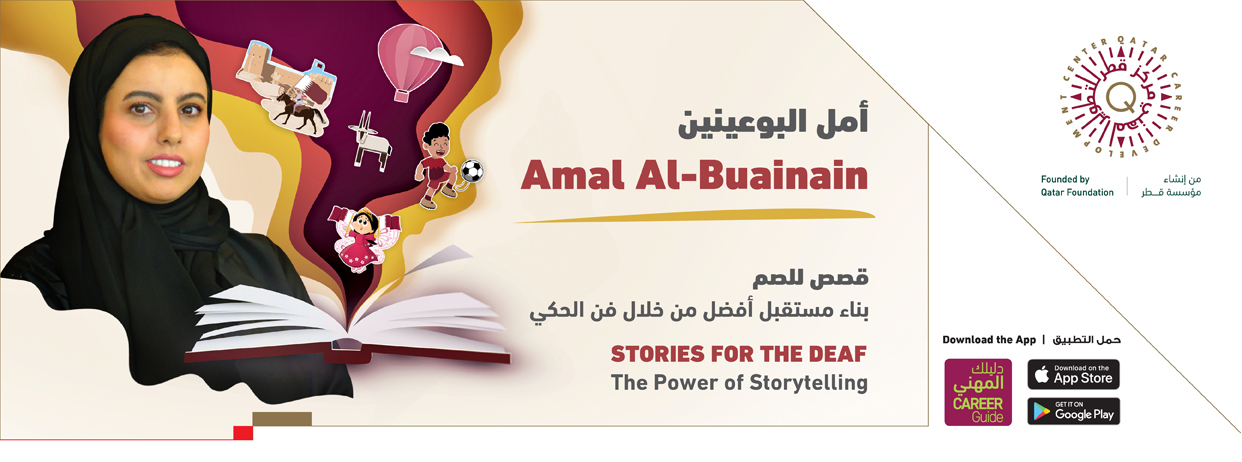
Amal Al-Buainain
The young innovator striving to create a brighter future for Qatar’s deaf community
Amid the vibrant atmosphere of the children’s section at the Doha International Book Fair, a group of curious youngsters gathers around a young woman holding a tablet. On the screen, Noura, a virtual character, uses sign language to narrate the story of “Treasure Island” by Qatari author Lina Al-Ali. The children are captivated, their faces lit up as they follow Noura’s vivid gestures, fully immersed in the unfolding adventure. The story follows a young girl who embarks on a thrilling journey with her grandfather to explore Bin Ghannam Island, located on Qatar’s eastern coast.
Most of the children in the audience are deaf, though a few hearing children sit among them, equally captivated by the story. They watch Noura’s hand movements, curious about what these silent signs could mean. Amal sees herself in these children, moved and grateful to witness their inclusion and joy as part of a community that values and celebrates them—something she longed for in her own childhood.
Noura is the virtual face of young Qatari entrepreneur Amal Al-Buainain’s project, “Stories for Deafs,” an app that translates children’s books from Arabic into Qatari Sign Language. Amal demonstrates to the children how to use the app to scan both illustrated and written stories, instantly receiving translations from Noura. “Every time I participate in a reading workshop and present the Stories for Deafs app to the children, their reactions fill me with immense joy. What makes me even happier is seeing the excitement of the hearing children as they try to mimic Noura’s signs and communicate with their deaf peers. Their enthusiasm motivates me to keep developing my project, hoping to foster a generation where deaf and hearing individuals can effortlessly connect through sign language; a glimpse of the future that makes this journey more exciting.”
A Brighter Future Through Storytelling
Amal believes her project has the potential to transform the future of Qatar’s deaf community. She is keenly aware of their challenges, especially the limited proficiency in Arabic among deaf individuals, particularly in writing—a gap compounded by the lack of high-quality, tailored content for the deaf. Furthermore, the information they receive is often incomplete or unclear, limiting their access to essential knowledge and resources.
Stories for Deafs helps deaf children learn Arabic by linking written words to their corresponding signs in a fun and engaging way, encouraging them to continue learning. Essentially, it acts as a visual dictionary that enhances their written language skills through sign language. This allows them to read more books, expand their knowledge, and foster cultural awareness. At the same time, the app offers hearing children the chance to explore and learn sign language, promoting better communication between deaf and hearing communities, and ultimately improving the quality of life for people who are deaf or hard of hearing. Amal understands the profound impact of mastering reading on a deaf child’s life.
Reading has been her passion since childhood, starting with illustrated stories that sparked her imagination. Over time, her curiosity expanded to a wide range of topics, with a particular interest in Qatari history and heritage, through which she developed a deep appreciation for her homeland’s beauty. Amal is also drawn to psychology books, driven by a desire to understand human behavior better and learn about personal development. Inspired by similar applications in foreign languages, Amal sought to innovate by creating an app with a virtual character that embodies Arab identity and can translate from Arabic into Qatari Sign Language. These are two key topics that rippled throughout her mission today.
From Vision to Reality
Although she had a clear vision, Amal realized that having an idea and conducting some initial research was not enough. She still had unanswered questions: Where should she start? What technologies and tools were needed to develop the app? She continued searching for answers until a friend told her about Mada – Assistive Technology Center and their support for projects to improve accessibility to information technology.
Amal met with experts from Mada, who expressed great interest in her idea. As a result, Stories for Deafs became one of the first projects adopted by the Mada Innovation Club initiative, launched in 2022 under the center’s umbrella. This initiative aims to enhance the capabilities of creators with disabilities in science, technology, engineering, and mathematics (STEM). It empowers them to turn their innovative ideas into solutions that address societal needs and improve accessibility to information and communication technology.
Club members are selected after carefully evaluating their ideas and gaining access to an environment that fosters innovation. They can also collaborate with experts from various fields, including consulting, research, technology, entrepreneurship, and project management. These experts help them develop comprehensive plans to transform their ideas into successful projects.
“The initial stages of development presented a unique set of hurdles,” Amal explains. “But thanks to the invaluable expertise of Mada, we were able to overcome them. A crucial aspect was designing and developing a virtual character that children could interact with. We meticulously designed Noura to embody a distinct Qatari identity, paying close attention to every detail, from her facial features and clothing to her lip movements.”
Amal continues collaborating with Mada to develop the app further, ensuring it has a lasting impact on deaf children in Qatar and the broader Arab region. She firmly believes that rapid technological advancements hold the key to unlocking more innovative solutions, enabling deaf individuals to communicate better with society, refine their skillsets, and tap into their creative potential.
A Long Way to Go
Despite Amal’s progress with her project, she believes that the true potential of the deaf community in Qatar will only be realized once their challenges are fully addressed. One key issue, she explains, is the lack of educators equipped with specialized knowledge, methods, and techniques for effectively teaching deaf students. This deficiency leaves students without proper educational guidance and behavioral support necessary to advance their career development.
Another significant challenge is the disparity in high school diplomas awarded to deaf students compared to their hearing peers. “This restricts our access to universities and ultimately hinders us from pursuing the careers we are passionate about. We are not offered the same options or equal opportunities as hearing students. Finding a solution to this issue is not impossible. Many Arab and foreign countries accept deaf students into universities and allow them to study a variety of disciplines. I hope this changes in the future, as it would allow deaf students to pursue careers that align with their ambitions and capabilities,” she says.
Amal actively collaborates with various institutions to raise awareness about the issues and challenges faced by the deaf community. She passionately participates in community events and activities, where she teaches sign language to children and shares stories through her Stories for Deafs app. Amal remains optimistic about the future of the deaf community in Qatar, and she explains why: “Social gatherings and community events always fill me
with immense joy. They serve as a powerful reminder that I am not alone in this journey and that we are moving toward a more inclusive future together. I believe Qatari society has become more aware of the challenges facing people with disabilities and recognizes the enormous potential within this group. I have noticed a growing interest from young men and women eager to engage with the deaf community, whether as supporters, collaborators, or volunteers. Their enthusiasm for integration and communication is truly inspiring.”
“Some people still look at us differently, driven by misconceptions about the deaf community and our abilities. To challenge these stereotypes, it is essential to integrate deaf and hard-of-hearing individuals into national events and social gatherings. Organizing more cultural seminars about the deaf community and sign language workshops can significantly raise awareness, promoting a deeper understanding of our community and language. This will pave the way for a more inclusive society where deaf individuals can fully participate,” she adds.
Amal encourages Qatari youth to engage with deaf associations nationwide. This interaction will drive a deeper understanding of the deaf community, their capabilities, and their needs. She believes that such connections will strengthen integration among all segments of society and help propel young people from diverse backgrounds forward. Amal also urges them to learn sign language and consider pursuing careers in sign language translation, as this would play a crucial role in amplifying the voices of the deaf community and providing a valuable service to society.
The young entrepreneur hopes to inspire Qatari youth to follow in her footsteps by developing projects that serve their community and contribute to building a brighter future for their country. She offers them the following advice: “You are bound to face challenges at the beginning. Remove the word ‘impossible’ from your vocabulary and never give up, no matter the obstacles. Keep pushing forward and remember that success often grows from the seeds of failure.”
About Mada
Mada – Assistive Technology Center was founded in 2010 to promote digital inclusion and build a technology-based community that meets the needs of persons with disabilities in Qatar. Today, Mada is the world’s leading Center of Excellence in digital access in the Arabic language. For more information about the center, its services, and programs, visit their official website: https://mada.org.qa/
Qatar Cultural Center for the Deaf
You can reach out to the Qatar Cultural Center for the Deaf to learn more about their activities and programs, including sign language courses, by visiting their official website: https://qdeafctr.com/