Building Bridge for a Better Tomorrow
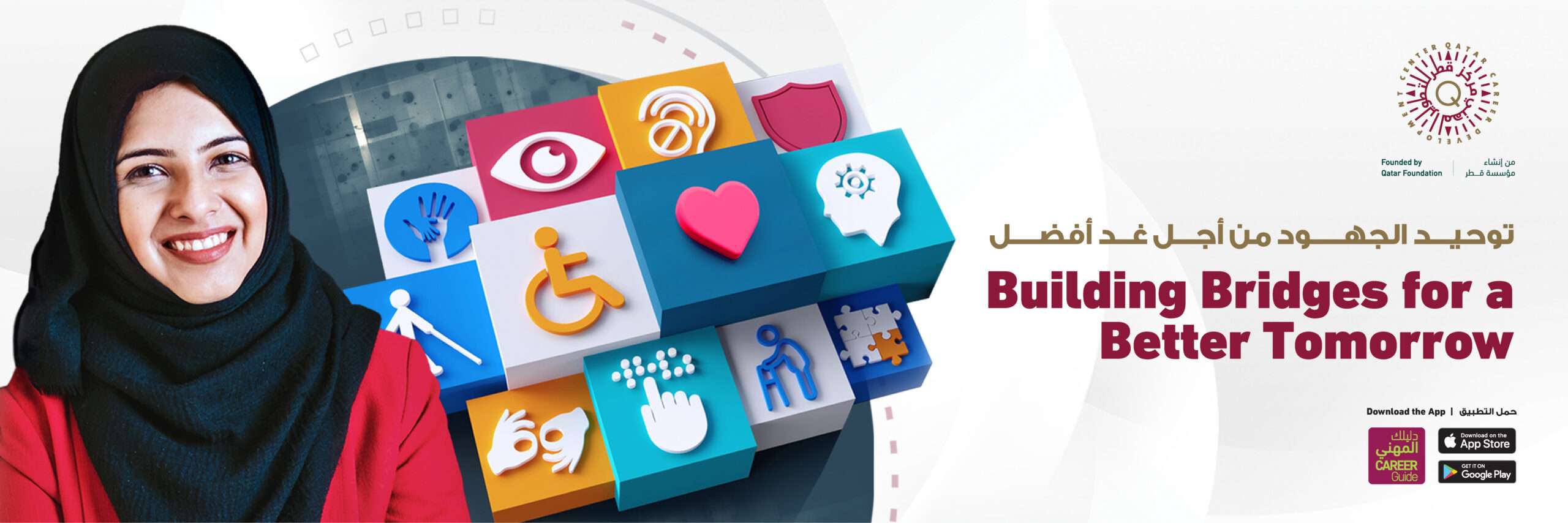
Empowering Change
Toward a more inclusive workforce
Interview with Sabika Shaban Disability advocate and founder of Qatar Disability Resource (QADR)
When Sabika Shaban launched the Qatar Disability Resource (QADR) in 2018, her mission developed from a deeply personal experience.
As a parent, she had faced the challenge of finding reliable, accessible information and guidance for families raising children with disabilities in Qatar.
What began as a small network to help families feel understood has since evolved into a national platform connecting about two thousand stakeholders, including families, educators, and professionals, driven by a shared commitment to inclusion.
Today, Sabika is recognized as one of Qatar’s leading voices in disability advocacy. A researcher, community builder, and changemaker, she serves on several national boards and taskforces, works as an administrator at Hamad Bin Khalifa University, and is pursuing a PhD in Education at the University of Cambridge. Her research focuses on disability and inclusive education in the Gulf, an area she hopes will shape more equitable futures for learners across the region.
In this interview, Sabika reflects on QADR’s journey from a grassroots idea to a nationwide community hub.
She discusses the challenges of building inclusion within evolving systems, the lessons learned along the way, and her vision for a more connected, lifelong support network for people with disabilities. She also offers valuable advice for employers on embracing neurodivergent talent and guidance for parents seeking to nurture their children’s potential with confidence and compassion
From Idea to Impact
To what extent has QADR achieved its original goals?
When I first started QADR, its foundational mandates were to connect and to inform. Within just the first few months, it made meaningful strides that far exceeded my initial goals. The wonderful part about goal setting is that it is never static; the horizon can keep moving as you continue the journey. As I took on new roles as a community activist and a researcher, QADR’s mission evolved as well. It expanded to include more practitioners, broadened the range of disabilities represented, welcomed adults with disabilities, and strengthened its effectiveness as a bridge within the community. QADR has grown into a trusted platform for both families and practitioners alike. It engages in advocacy, supports research, and provides a safe, empowering space where many community members have found their own voices, as well as their support groups.
What major challenges did you encounter along the way?
One of the biggest challenges has been navigating systems that are still shaping their understanding of what meaningful inclusion truly means. At times, progress slows because of institutional inertia, limited collaboration across sectors, or a narrow perception of disability. Working both within and beyond formal institutions has taught me how to adapt my activism to fit the realities of our context and to find ways to keep moving forward, even when change feels gradual.
Another challenge has been the emotional labor involved. QADR is intensely personal. It is grounded in my own experience as a parent and in the stories of countless families and self-advocates whom I care about deeply.
That creates both a sense of purpose and a constant need to manage expectations – my own and others’. Progress can be slow, and while each individual win is meaningful, lasting systemic change requires time, patience, and persistence.
What key lessons have you learned from the whole experience?
One of the most important lessons I have learned is to never wait for perfect conditions before moving forward with a project you truly believe in. Persistence matters more than perfection. I have learned to trust the process, stay true to the values that guide QADR, and celebrate small victories along the way.
Above all, I have learned to keep the voices of disabled people and their families at the heart of everything that I do.
What is next for the project?
Looking ahead, I see two key priorities already taking shape. The first is developing an online repository to host our community-generated guides and resources, making them easily accessible to all.
The second is strengthening QADR’s role in shaping progressive disability policymaking in Qatar, ensuring that the insights and experiences of our community continue to inform lasting change.
Rebuilding The System
What do you hope for when it comes to building a sustainable support system for people with disabilities?
Through my work with QADR, I have seen how families often struggle to navigate systems that are well-intentioned but fragmented. For me, a sustainable support system means coordinated, lifelong care that does not depend on personal connections or the ability to self-advocate. It is a system built on responsiveness, one that hears the experiences of people with different disabilities and inclusion needs, as well as their families.
I hope to see a shift from one-off “awareness sessions” to more meaningful, action-oriented programs that focus on building capacity and driving real change. For too long, uncertainty about how best to offer support has left many talented individuals excluded from career development, for instance, and employment opportunities
How can we achieve this?
To move forward, with particular reference to the neurodivergent population, we must design solutions that are systematic and supported by policy, practice, and culture for people with different neuro-profiles, across all stages of life, from early childhood to employment and beyond.
This requires breaking down silos, cocreating initiatives that respond directly to community needs, and ensuring that inclusion becomes an everyday reality rather than the exception.
How can career guidance and development play a central role in building a better future for neurodivergent individuals?
The first and most critical step is to develop career experts who are genuinely committed to inclusive, neurodiversity-aware career development. Building this foundation ensures that guidance and support are rooted in understanding and empathy, not assumption.
Equally important is the need for career professionals to co-create mechanisms that respond to diverse needs. This begins with active engagement with neurodivergent people with different conditions, abilities, and ages, and mapping their journeys to identify the points where their experiences “diverge” from those of neurotypical youth.
The key is shifting the question from “What support does this person need?” to “What environments help them thrive?”. Career development programs that include inclusive mentorship, internships, and exposure to different fields can open doors that were once closed.
These initiatives have powerful potential to challenge and transform the systems around them, and open possibilities for mindset shifts of employers, peer employees, and other stakeholders.
Around the world, neurodivergent individuals have achieved remarkable career success across many sectors. Are you seeing similar stories emerge in Qatar?
We are beginning to see some encouraging stories of success, but the limitations of the current system are also clear. Many neurodivergent individuals, particularly those with ADHD, have learned to adapt quietly in the workplace, often without formal accommodation or open disclosure. Actually, in several cases I have encountered, people were only diagnosed later in life, after already securing employment. Without a culture of privacy-protected formal disclosure and structured support, many continue to navigate their careers largely under the radar.
Furthermore, individuals with autism remain underrepresented in the mainstream workforce, though some who have benefited from consistent high-quality support throughout their early development are pursuing promising paths in art, academia, medicine, and other fields. These journeys are still unfolding, and the transition into formal employment continues to be a significant challenge for many
What do you think helps some neurodivergent individuals succeed while others still face barriers in finding or keeping jobs?
One factor that consistently appears across success stories is the presence of a champion; someone who believes in the individual and actively supports their path, whether a parent, teacher, mentor, or employer.
However, success should not depend on the chance presence of a single advocate. It must be embedded in accessible, sustainable systems that allow neurodivergent individuals to pursue meaningful careers as readily as anyone else.
What are the most common misconceptions about the capabilities of neurodivergent individuals?
Unfortunately, a common misconception about neurodivergent individuals stems from the way many employers view people primarily as “capital”, prioritizing efficiency and conformity over creativity and inclusion. This mindset often fuels misconceptions that neurodivergent individuals are fragile, unproductive, or a drain on resources.
Much of this misunderstanding comes from the fear of the unknown and lack of awareness. It is also quite common for all stakeholders—like parents, educators, employers, policymakers, and even youth with disabilities themselves—to underestimate their own potential and the value they can bring to an organization.
Where do you see the main challenge?
One of the main challenges lies in how communication styles are often mistaken for competence. A different way of expressing oneself is frequently seen as a deficit rather than a reflection of a unique perspective or strength. At the same time, navigating a world that is full of people with different abilities, capacities, and profiles, is a skill that is rarely taught in formal settings.
People either learn about neurodiversity when they discover their own diagnoses or have family members who are neurodivergent, or are in a disability-related profession. Until we broaden our definition of ability, and disability, in the workplace, we risk overlooking the contributions and value that neurodivergent individuals can bring.
Key Steps
What message would you like to share with employers who may hesitate to hire neurodivergent candidates?
I encourage employers, particularly HR professionals, to take proactive steps to address the uncertainties around inclusive employment.
Start by learning about neurodiversity and neurodivergence, inviting trainers, and creating opportunities to meet and listen to neurodivergent individuals. These interactions can be transformative, turning what may seem like a complex challenge into a feasible, rights-based opportunity for growth.
Next, reflect on your own values and those of your institution. Consider how poorly the current reality of highly-exclusionary hiring and retention practices reflect institutional values, and where change is needed for better alignment.
Finally, start small if you feel less prepared for neurodivergent employment. Nervousness is natural, but can be redirected into opportunities for growth. Small steps could include offering internships or time-bound contracts with clearly defined tasks. Seek partners who can help support employment transitions, learn best practices, and adapt them to your unique context.
Inclusive employment is not about lowering standards. It is about widening the lens through which we recognize and value talent.
What advice do you have for parents who want to prepare their neurodivergent children for career success from a young age?
When it comes to preparing children for career success, it is important to recognize that they may not follow conventional paths, and that is perfectly okay. What matters is starting early: encouraging curiosity, building routines that foster confidence and communication, and providing exposure to different experiences.
The advice comes from a place of humility, as I speak both as a parent of two neurodivergent children and as someone aware that neurodivergence is an incredibly broad spectrum. We can never fully understand the potential of our children unless we are intentionally “discovering” them rather than assuming their abilities are fixed.
This process becomes easier when you partner with fellow parents who share their own stories or with professionals who appreciate and nurture every aspect of our children. With the right supports and systems in place, our horizon continues to expand when it comes to neurodiverse opportunities in the workplace.